The shine on a brand-new car looks different from the shine on a three-year-old car, and the difference has nothing to do with how clean either one is. Wash both vehicles to identical standards, and the new one still reflects light better. The reason sits in microscopic damage to the clear coat that accumulates over time and disrupts how light actually behaves on the surface.
This is what paint correction addresses, and it is the most technical skill that professional auto detailing in Toronto performs regularly. The work involves the precision removal of surface defects through controlled abrasive levelling of the clear coat. Done well, it restores the optical clarity that makes paint actually look like paint rather than a slightly hazy, slightly dull version of itself.
The post below covers what paint correction actually does at the surface level. The different types of defects involved. The technical decisions behind compound selection and machine choice. The optical physics explains why corrected paint looks dramatically different from uncorrected paint. The relationship between correction work and the long-term protective coatings that follow it.
The Anatomy of a Scratch
Most surface defects on car paint fall into three categories. Each one needs to be correctly identified before corrective work begins, because the depth and structure of the defect determine which approach actually fixes it.
Clear coat swirls are the most common defect on vehicles older than a few months. They appear as fine circular or spiderweb-pattern scratches visible under direct light, particularly sunlight or focused LED inspection lighting. Swirls sit only in the clear coat layer and rarely penetrate to the base paint beneath. The damage comes from improper washing techniques, automatic car wash brushes, and contact with dirty drying towels over months and years of regular use.
Light scratches go a little deeper into the clear coat. The scratch is visible to the naked eye under most lighting conditions and can sometimes be felt with a fingernail run across the surface. Light scratches usually result from brushing past keys, jacket zippers, or branches when parking near landscaping. The clear coat layer is typically 1.5 to 2 mils thick on most factory paint jobs, which gives correction work meaningful room to remove material safely.
Deep oxidation and severe scratches present the hardest correction challenges. Oxidation appears as a chalky, faded look across the paint, particularly on horizontal panels like the hood and roof that catch direct UV exposure. Deep scratches penetrate through the clear coat into the colour layer underneath, sometimes reaching the primer or bare metal. These defects require careful assessment because aggressive correction work could compromise the remaining clear coat or expose more serious damage.
Abrasive Technology and Machine Polishing
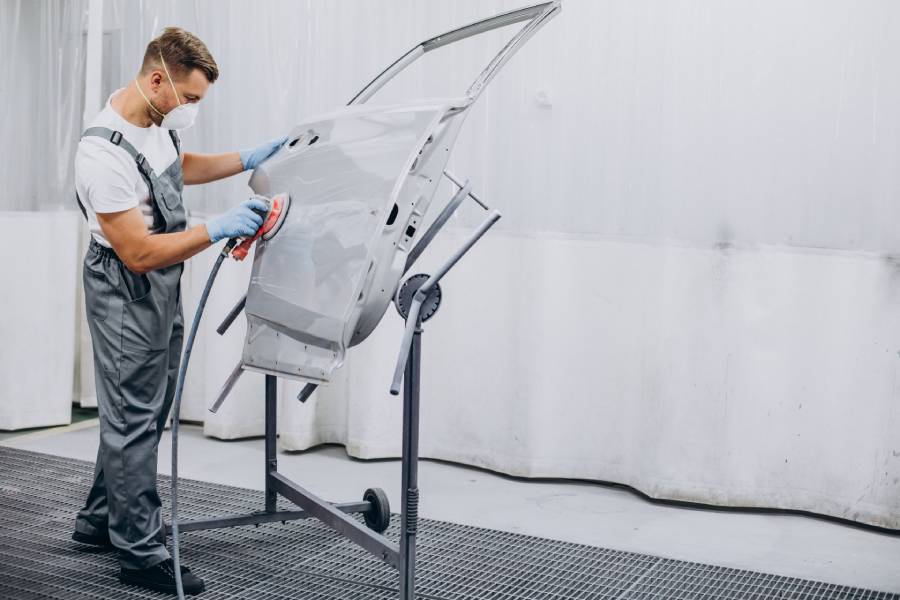
Modern paint correction relies on a careful pairing of polishing compound and machine polisher. The compound contains microscopic abrasive particles suspended in a lubricating medium. The machine applies controlled pressure and rotation that levels the clear coat by removing a measured amount of material from the high spots around each defect.
Compound aggressiveness runs across a spectrum. Cutting compounds contain larger abrasive particles and remove material faster, making them suitable for removing material from deeper defects in hard clear coats. Polishing compounds use finer abrasives and remove material more gradually, finishing the surface to a clean state after cutting work is complete. Finishing polishes contain the smallest abrasives, refining the surface to optical clarity. Most professional correction jobs use multiple compounds in sequence, working from aggressive to fine across two or three stages.
Machine selection matters as much as compound selection. Rotary polishers spin in a single direction at high speeds, removing material quickly but generating heat that can damage paint if mishandled. Dual-action polishers use an oscillating motion that distributes work over a wider area, reducing heat buildup and making them safer for less-experienced technicians. Forced-rotation dual-action machines combine the safety of dual-action movement with the cutting power of rotary polishers. Each tool serves different correction scenarios.
The technical skill comes from reading the paint as work progresses. Paint thickness varies significantly across panels and across different vehicles. A 1995 vehicle might have substantially thicker clear coat than a 2024 vehicle from the same manufacturer. Modern thin clear coats demand careful measurement with electronic paint thickness gauges before aggressive correction work begins. Removing too much clear coat creates problems worse than the swirls being corrected.
Enhancing Depth and Clarity Through Light Reflection
Paint looks like paint because of how light interacts with the surface. A perfectly smooth clear coat reflects light at consistent angles, which the eye reads as deep, clear, and saturated colour beneath. A clear coat full of microscopic scratches scatters light in random directions, which the eye reads as haziness, dullness, and reduced colour saturation, regardless of how technically clean the surface is.
This is why corrected paint looks dramatically different even though the underlying colour has not changed. The correction work has not added anything new to the paint. It has removed the surface roughness that was disrupting normal light reflection. The colour that was always there comes through clearly once the optical interference is gone.
Depth perception in paint comes from the same physics. Deep, three-dimensional-looking paint reflects light cleanly enough for the eye to perceive layers beneath the surface. Hazy paint flattens the visual impression because scattered light prevents the eye from seeing through the clear coat into the colour below. Correction restores the optical depth that makes paint look like paint rather than looking like a coated panel.
This effect explains the experience most owners report after their first professional correction service. The car looks like a completely different vehicle, sometimes startlingly so. The colour appears richer. The shine appears wetter. The clarity makes details visible that were always there but visually muddied by years of accumulated micro-damage.
Preparing for Long-Term Protection
Paint correction is not the final step in any serious detailing job. It is the preparation step that makes the actual final step possible. Ceramic coatings and paint protection film both require a pristine substrate to bond and perform as designed. Skipping correction means locking in every defect beneath the protective layer, making it substantially harder to fix later.
Ceramic coatings chemically bond to the clear coat surface, forming a hard sacrificial layer that resists contamination, UV damage, and minor abrasion. The bond depends on the absolute cleanliness of the underlying surface. Any swirls, oxidation, or contamination present during application become permanent features visible under the coating for the next two to five years until the coating is removed or wears off.
Paint protection film, called PPF, works similarly. The thermoplastic urethane film bonds to the clear coat with a pressure-sensitive adhesive, and any trapped defects show through the transparent film over the installation’s lifespan. PPF installations on uncorrected paint produce visible disappointment when the high-gloss film reveals every imperfection the owner hoped it would hide.
Order of operations matters significantly. Correction first, then coating or film. Anything else inverts the value of both procedures and creates results that will require expensive remediation when the underlying paint condition can no longer be hidden.
The Optical Foundation Behind Every Great Finish
Paint correction sits underneath every premium finish on every well-maintained vehicle. The work is invisible in the sense that it removes rather than adds, but the visual transformation is what separates a professionally finished vehicle from a clean one. The optical clarity produced through proper correction work cannot be replicated through any other process or product.
For Toronto drivers looking to restore the optical clarity of their paint before applying a ceramic coating or paint protection film, or simply to bring back the depth a vehicle had when it left the factory, Colibri Car Wrap and Detailing handles precision paint correction as part of its full auto detailing service menu in Toronto. The team there approaches each vehicle with paint-thickness measurement and stage-by-stage compound selection that define the difference between basic polishing and proper correction work.
Featured Image Source: https://www.magnific.com/free-photo/car-mechanic-polishing-car-before-painting_16934338.htm#fromView=search&page=1&position=3&uuid=de0137e4-dc10-4985-adf4-34d6958d16f3&query=car+paint+work